

A friendly email about a prospective business partner’s prototype may not feel like patent evidence. Neither does a design team’s decision to use a similar mechanism. But in Google LLC v. DDC Technology, LLC, those real-world reactions helped carry the day even after the Patent Trial and Appeal Board (PTAB) found that prior art taught every limitation of certain claims and that a skilled artisan would have been motivated to combine the references with a reasonable expectation of success. As a result, a panel of the Federal Circuit affirmed the PTAB’s rulings that Google had not proved the surviving claims of three smartphone VR-viewer patents obvious.
The Technology: Pushing a Button Without Touching the Phone
The three patents-at-issue, U.S. Patent Nos. 9,420,075, 10,528,199, and 11,093,001 (DDC patents), address a practical problem with smartphone-based virtual reality viewers. Once a phone is tucked inside the viewer, its touchscreen becomes difficult to access. The solution disclosed in the DDC patents lets the user operate an input mechanism from outside the housing (identified as 722 in the figure to the right) to generate a touch event on the enclosed phone. Think of it as giving your finger a mechanical stand-in.
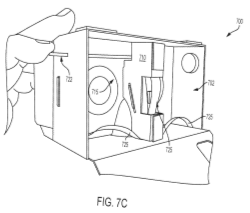
Google challenged claims of all three patents using the same two references: Kondo, describing a smartphone viewer with a remote touch circuit, and Chu, describing a touchscreen actuator for a waterproof housing. Google proposed replacing Kondo’s circuit with an embodiment of Chu’s actuator. Some challenged claims fell. Others survived for different reasons, including objective evidence of nonobviousness, claim construction, and failures of proof. Google appealed the surviving claims and lost.
Obvious on Paper? Not the End of the Inquiry
Google cleared significant hurdles for claim 1 of both the ’075 and ’199 patents. The table below reproduces the text of those claims from the respective patents.
| ʼ075 Patent | ʼ199 Patent |
| 1. A virtual reality viewer for use with a mobile electronic device having a touchscreen, the viewer comprising: a housing configured to receive the mobile electronic device, wherein the housing is configured to hold the mobile electronic device such that the touchscreen is generally centered in a horizontal direction and directly in a user’s field of view when looking into a generally hollow interior of the housing through a side opposite the touchscreen; an input mechanism that is accessible from an exterior of the housing and is moveable within the interior between at least a first position and an extended position, the input mechanism comprising: an electrical shield having a surface, wherein only a portion of the surface of the electrical shield is configured to contact a central region of the touchscreen of the mobile electronic device when the input mechanism is in the extended position. | 1. A virtual reality viewer for use with a mobile electronic device having a touchscreen, the viewer comprising: a first lens and a second lens, wherein the first lens is facing the same direction as the second lens, and wherein the first lens and the second lens are spaced apart in a horizontal direction; a frame having a first side and a second side opposite the first side, the first side configured to hold the first lens and the second lens, the second side configured to receive the mobile electronic device, wherein the frame is configured to hold the mobile electronic device such that the mobile electronic device is generally centered in a horizontal direction and directly in a user’s field of view when looking through the first side of the frame; and a touchscreen input constructed of material and having a surface such that only a portion of the surface of the touchscreen input is configured to contact a central region of the touchscreen of the mobile electronic device when the touchscreen input is activated. |
For those two independent claims, the PTAB found that the combination of Kondo and Chu taught every limitation and that a skilled artisan would have had both a motivation to combine and a reasonable expectation of success. Those findings, however, did not end the inquiry. The PTAB also found strong evidence of copying and gave industry praise moderate weight. Considering the record as a whole, it concluded that Google had not proved obviousness by a preponderance of the evidence.
Google attacked both categories of objective evidence. On copying, it argued that the PTAB had improperly compared the allegedly patented product and allegedly copied product to the claims rather than to each other, and had disregarded differences between the mechanisms. The appellate panel soundly rejected both characterizations. It found that the PTAB had compared Google’s GCV2 viewer with the DODO case viewer and inventor Patrick Buckley’s prototype, and also had considered differences in attachment and materials without finding them sufficiently significant to defeat substantial similarity.
That distinction matters. The panel explained that showing a competing device meets the patent’s limitations is not, by itself, proof of copying. The inquiry instead asks whether the accused copier reproduced another product. Evidence that the developer encountered that product and later produced a substantially similar design can support that inference. This was an obviousness analysis, not a ruling on infringement or willfulness.

The praise evidence raised a different question: How much should informal technical compliments count? Google engineers responded to videos of Buckley’s prototype with “[t]hat button is genius” and “[t]hat’s an ingenious button!” Google argued that these were biased compliments exchanged in a developing business relationship rather than independent industry praise. While a fair point for Google to raise, the PTAB had already accounted for it. It reduced the emails’ probative value because of their interpersonal and commercial context and treated a third response — “[t]hat button looks really neat!” — as politeness rather than praise. The Federal Circuit nevertheless held that substantial evidence supported the PTAB’s finding that the other two emails constituted industry praise.
The lesson here is not that a few enthusiastic emails establish patentability. Rather, here they were part of a larger record that included strong copying evidence. Nor is the lesson to discourage honest technical reactions. It is to recognize that ordinary business communications can later illuminate how others responded to the claimed technology. That is the role of objective evidence: to help test whether an apparently straightforward reconstruction rests on hindsight. The next question is how that evidence weighs against the prior-art showing.
The Harder Question: How Much Does Each Side Actually Weigh?
The balancing question was central to Google’s appeal. Google argued that its assertedly strong obviousness case outweighed DDC’s secondary-considerations evidence. The panel recognized that, under its precedent, comparatively weak objective evidence may be insufficient when the evidence supporting obviousness is much stronger. It concluded, however, that Google’s description did not fit this record. Importantly, Google challenged whether the evidence established copying and praise, but did not separately challenge the weight the PTAB assigned to either finding. The court therefore left those factual weight assignments undisturbed while reviewing the ultimate legal conclusion de novo. A more focused appellate challenge might have addressed those assignments directly, as well as explaining why the prior-art findings established obviousness on the complete record.
Even so, the balancing discussion invites a closer look. The court stressed that the PTAB never characterized Google’s evidence as “strong,” that the motivation to combine was contested, and that the PTAB rejected two proposed rationales before accepting another. Rejecting two rationales does not necessarily make the accepted rationale weak, just as labeling copying “strong” does not quantify its force against a supported combination of references. The panel did undertake the ultimate legal analysis and found no error on this record. The narrower question for future cases is how explicitly that analysis should explain the balance once the underlying factual weights are fixed.
Claim Construction: Relationships Count, Not Just Parts
Not all of the surviving claims turned on that evidentiary balance. Other disputes concerned what the claims required in the first place. For claim 18 of the ’075 patent, Google attacked a supposed requirement that “disposed on” meant direct contact. The problem was that the PTAB had not imposed that requirement. It had excluded indirect connections that were “far removed.” The Federal Circuit upheld that result based on the specific structural pairings in the claim and the use of “disposed” as “located” in the specification. The holding does not make direct contact a requirement of “disposed on” in this claim, much less establish such a rule for every patent.
Claim 20 of the same patent likewise turned on construction. The court affirmed the construction of “lever” as “a stiff body pivoted on a fulcrum,” relying on the disclosed mechanism and a mechanical-engineering dictionary. Because Google’s obviousness theory depended on a broader construction, that ruling was sufficient to affirm the PTAB’s conclusion on claim 20 of the ʼ075 patent. The panel therefore did not reach Google’s separate challenge to the PTAB’s finding that Chu lacked the claimed “guide” limitation.
Together, these construction rulings demonstrate that it is not just whether every component appears somewhere in the references, but whether those components have the claimed relationships under a defensible construction.
When the PTAB Invites More Evidence, RSVP
The remaining disputes moved from the substance of the claim mapping to whether Google had adequately developed and defended it. For claim 27 of the ’001 patent, Google mapped a “linkage element” to both Chu’s spring and shaft, but supported flexibility only for the spring. The PTAB invited more argument and evidence at institution. Google did not further address the claim in its reply.
That omission also undermined Google’s procedural objection on appeal. Google argued that the PTAB had sprung an implicit construction requiring the linkage to be made only from flexible material. The panel found no Administrative Procedure Act (APA) violation: Whether or not the final decision implicitly construed the term, the PTAB had not unexpectedly changed an earlier construction, and Google had notice that its position needed development. The panel also distinguished a finding that the shaft was inflexible from the actual ruling that Google had failed to show it was flexible. Google did not challenge that failure-of-proof determination, which the court left undisturbed.
Those are not interchangeable propositions. The party carrying the burden can lose because the proof is missing, without the PTAB affirmatively proving the opposite.
Key Takeaways
- Prior-art claim mapping is not the whole obviousness analysis. For certain claims, evidence of copying and industry praise outweighed findings that the references taught every limitation and that a skilled artisan would have combined them with a reasonable expectation of success.
- Turn invitations into action lists. Require a claim-by-claim response to the PTAB’s expressed concerns, within the proceeding’s procedural limits. Google’s problem was not simply that an engineer called a button “genius.” It was that the full record mattered, and parts of the record Google needed were never adequately developed. The practical response begins with the PTAB’s own signals: When it identifies a gap, address it before the final written decision.
- Audit the evidence outside the patents. Ask early about prototypes, access, engineering correspondence, and contemporaneous design records. For patent owners, preserve evidence connecting the market’s reaction to the claimed features. For challengers, investigate and document genuine independent-development explanations and material technical differences where the facts support them.
- Ask two different questions. Does the evidence establish copying or praise, and what weight should it receive? The opinion’s treatment of Google’s appeal shows why disputing the first does not necessarily preserve a challenge to the second.