

On June 2, 2026, the Federal Circuit issued a precedential decision in AGI SureTrack LLC v. Farmers Edge Inc. that delivered a split result — and a reminder that winning a patent case is not the same thing as collecting fees for it. The panel (Judge Haldane Robert Mayer, writing, joined by Chief Judge Kimberly Moore and Judge Alan Lourie) affirmed the District of Nebraska’s summary judgment that AGI’s asserted patents claim ineligible subject matter under 35 U.S.C. § 101. But the court vacated and remanded the district court’s separate determination that the case was not “exceptional” under 35 U.S.C. § 285, faulting the lower court for entering that ruling sua sponte and without any explanation. In short, Farmers Edge won the patent challenge but, for now, walks away with only its costs. The harvest, it turns out, is not yet in. Let’s dig into the dirt.
Background
AGI SureTrack LLC owns a family of patents — including U.S. Patent No. 11,126,937 — directed to automated systems for capturing, processing, and sharing farming data in real time. The technology centers on a “relay device” that attaches to farming equipment and pulls operational data off the machine’s message bus while the equipment works the field. Claim 1 of the ’937 patent, treated as representative, features a relay device that includes familiar parts — a microprocessor, a bus connector, a GPS receiver, and a memory storage area — along with software that matches the equipment to a stored “implement profile,” decodes its messages, and records the farming operation in an electronic farm record.
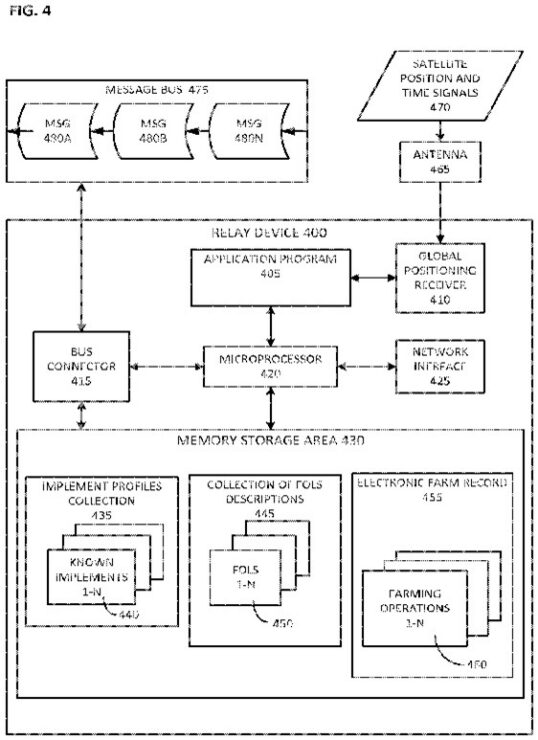
AGI sued Farmers Edge Inc. and Farmers Edge (US) Inc. in the District of Nebraska for infringing claims of the ʼ937 patent, as well as claims of U.S. Patent Nos. 10,963,825, 11,164,116, 11,361,261, and 11,507,899. In April 2024, the district court granted Farmers Edge summary judgment, holding the asserted patents directed to patent-ineligible subject matter under § 101. The court described the claims as using “generic (‘off the shelf’) computers and sensors to collect data from standard farm implements” and found nothing in the elements — alone or in combination — that transformed the abstract idea into an inventive concept as required under § 101. In the same summary judgment order, the court also determined that the case was not exceptional for purposes of an attorneys’ fees award under § 285. AGI appealed the eligibility ruling; Farmers Edge cross-appealed the no-exceptionality determination.
The Federal Circuit’s Analysis
Eligibility: An old idea even when narrowed to a farm is still abstract
Applying the two-step Alice framework, the panel agreed with the district court at both steps. At step one, AGI argued its claims solved a real-world “interoperability” problem among different brands of farm equipment that encode data differently. The court was not persuaded — noting first that nothing in the claims actually mentions interoperability and, second, that even crediting AGI’s framing, claims reciting “generalized steps of collecting, analyzing, and presenting information, using nothing other than the conventional operations of generic computer components, are directed to abstract ideas.” Limiting the data to a particular variety (here, farming data) does not save them: “an abstract idea remains an abstract idea even when narrowed — e.g., by subject matter — to a particular use or environment.” Replanting an old idea in a new field, in other words, does not make it a new crop. The “implement profiles” AGI leaned on were, in the court’s view, just one set of data used to decode another set of data, which “merely adds one abstract concept to another.”
At step two, the panel’s search for an inventive concept came up empty — a field plowed with nothing left to reap. The claims relied on generic components — microprocessor, bus connector, GPS receiver, memory — used in a conventional way, and the only real advantage AGI could point to was speed. But “the improved speed inherent with applying [an] abstract idea using a computer” does not supply an inventive concept. With no specific improvement to computer functionality disclosed, the court affirmed the ineligibility ruling.
Exceptionality: The appellate panel can’t review a ruling that explains nothing
This is where the decision earns its keep for fee-motion watchers. On the cross-appeal, Farmers Edge argued the case was exceptional under § 285 for a litany of reasons — alleged inequitable conduct during prosecution, misleading statements about abandoned claims, improper litigation tactics, and violations of court-issued protective orders. The problem was not the merits of those arguments; it was that the district court never reached them on the record. It entered the no-exceptionality ruling sua sponte, in terse fashion, without giving Farmers Edge an opportunity to present argument and evidence — and without explaining its reasoning. The lower court, in effect, harvested the conclusion without ever tilling the ground beneath it.
Citing Octane Fitness, the panel reaffirmed that an exceptional case is “one that stands out from others” on the substantive strength of a party’s position or the unreasonable manner of litigation, judged on the totality of the circumstances. While the court acknowledged it does not always require a district court to spell out why a case is not exceptional — sometimes the record speaks for itself — here there was “nothing in the district court’s terse no exceptionality ruling or the record on appeal” that would allow meaningful appellate review for abuse of discretion. Following Superior Fireplace, Energy Heating, and Innovation Technologies, the court vacated and remanded with instructions that the district court reassess exceptionality after giving both sides an adequate opportunity to be heard — sending the question back to be properly cultivated before any fee award is reaped.
The court also handed Farmers Edge a procedural lifeline. AGI argued that Farmers Edge had forfeited any fees claim by not moving within 14 days of the original judgment under Rule 54(d)(2)(B). The appellate panel disagreed and explained that under the Rule’s 1993 Advisory Committee Note, a new 14-day filing period “will automatically begin if a new judgment is entered following a reversal or remand by [an] appellate court.” Because the panel was vacating and remanding, a fresh 14-day window for a fee motion will open for Farmers Edge once the district court enters judgment on remand — a second season to sow its fees claim.
Key Takeaways
- New ground does not always make an old idea bloom. Limiting data-collection-and-analysis claims to a particular field — here, farming — does not automatically transform an abstract idea into eligible subject matter.
- A faster tractor moving over the same field harvests nothing new. Having a computer perform routine tasks more quickly or more accurately is not enough to make a claim patent eligible — speed alone is not an inventive concept at Alice step two.
- Clearing the back forty does not necessarily mean the barn gets built. An Alice-based summary judgment is a merits victory, but it does not by itself make a case “exceptional.” The § 285 inquiry is separate and turns on the totality of the circumstances under Octane Fitness — clearing the back forty does not necessarily mean the barn gets built.
- You cannot expect a prize at the county fair for a pie when no one can see the recipe. A district court that finds a case unexceptional under § 285 must give “some indication of the reasoning underlying its decision.”